- Today
The person who needs CPR might be someone you love
- Australian First Aid Institution
- First Aid Education
Why knowing your DRSABCD action plan, including how to give rescue breaths, could make all the difference.
When we think about performing CPR, many of us picture a stranger collapsing in a shopping centre, on the footpath or at the beach. We imagine rushing to their assistance, calling an ambulance and starting chest compressions while waiting for paramedics to arrive.
But what if the person who needs CPR isn't a stranger?
What if it's your partner, your mum or dad, a friend sitting across the dinner table or someone you work with?
The reality is that cardiac arrest is much closer to home than many people realise.
According to the Australian and New Zealand Out of Hospital Cardiac Arrest Registry (Aus-ROC), approximately 78% of out-of-hospital cardiac arrests attended by emergency medical services in Australia in 2022 occurred in a private residence. That's almost four out of every five cardiac arrests happening at home.
We don't have a national statistic that tells us precisely how often the person providing CPR knows the person experiencing cardiac arrest. However, when so many cardiac arrests occur in private residences, it is worth considering just how likely we are to be helping someone within our own circle.
Learning CPR isn't just about being prepared to help a stranger. It's about being prepared to help the people we love.
At Australian First Aid Institution, we provide practical CPR and first aid training on the Sunshine Coast. We believe understanding why we perform CPR, as well as knowing how to perform it, helps people become more confident and capable when it matters.
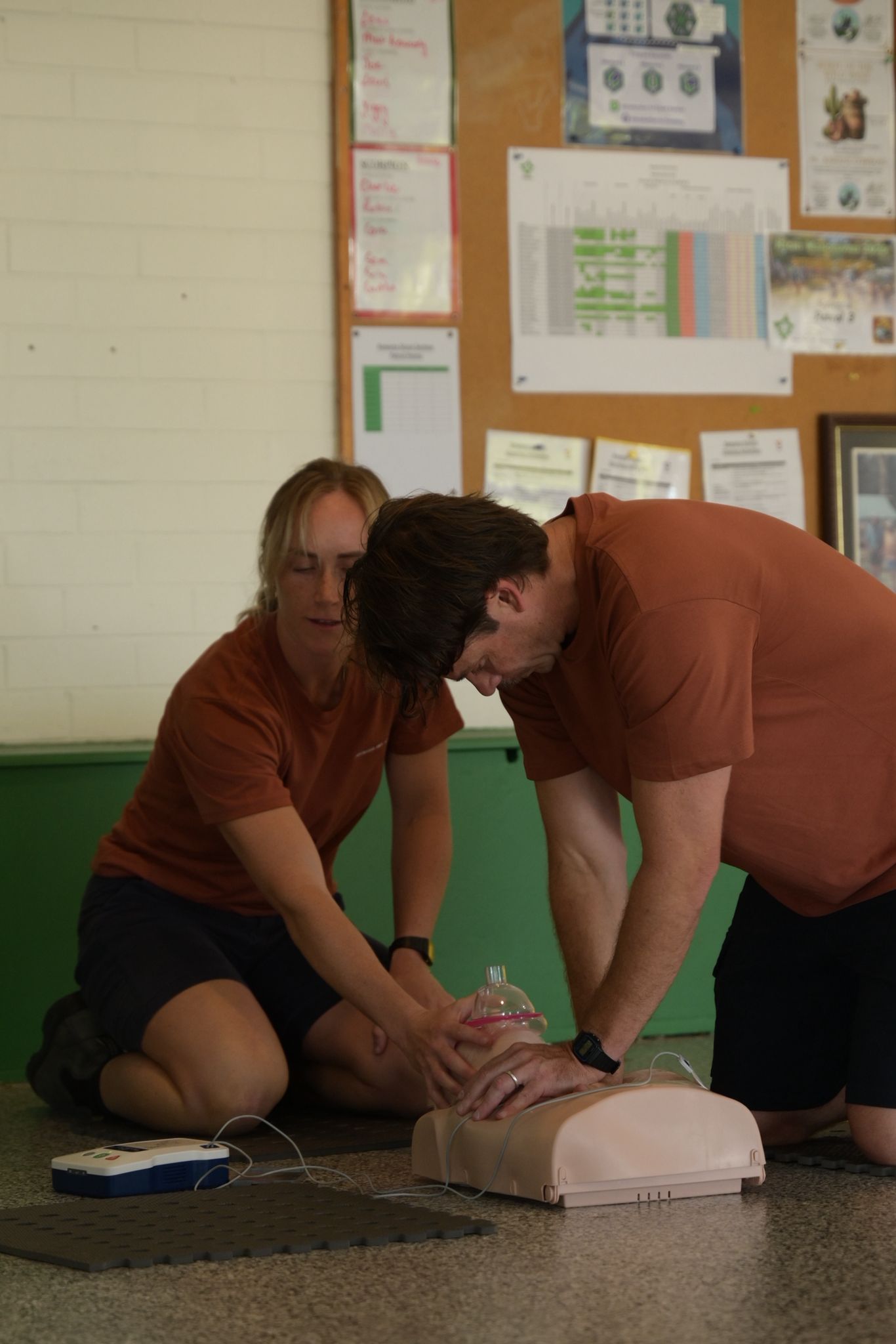
Knowing what to do matters
When someone collapses and becomes unresponsive, it can be confronting. Adrenaline kicks in, people start shouting, and it can be difficult to think clearly.
This is exactly why we teach the DRSABCD action plan.
Rather than relying on memory alone or trying to work out what to do next, DRSABCD provides a structured approach to assessing an emergency and delivering appropriate first aid.
The first step is Danger. Before approaching, check the surroundings for anything that could put you, other bystanders or the person in danger. There is little benefit in creating another casualty.
Next is Response. Check whether the person responds when you speak to them loudly and firmly squeeze their shoulders.
If there is no response, Send for help. Call Triple Zero (000), or direct someone else to make the call. Put the phone on speaker so you can continue providing assistance while speaking with the emergency call taker.
Next comes Airway. Open the person's mouth and check for obvious obstructions. If there is no obstruction, open the airway using a head tilt and chin lift.
Then comes Breathing. Look, listen and feel for normal breathing for no more than 10 seconds. This is an important distinction. Occasional gasps, snorting sounds or irregular breathing are not normal breathing. These can be agonal respirations, which sometimes occur during the early stages of cardiac arrest.
If the person is unresponsive and not breathing normally, assume cardiac arrest and start CPR.
Finally, Defibrillation. Apply an automated external defibrillator (AED) as soon as one becomes available and follow its voice prompts.
Following this sequence gives you a clear pathway through an otherwise chaotic situation. Each step has a purpose, and each one contributes to giving that person the best possible chance.
CPR is more than chest compressions
There is a reason the word cardiopulmonary contains both cardiac and pulmonary. CPR is about the heart and the lungs.
Chest compressions are essential because they generate blood flow around the body when the heart is no longer effectively pumping. This helps maintain some circulation to vital organs, particularly the brain and heart, until normal circulation can be restored.
But there is another important part of the equation: oxygen.
Our brain and other vital organs rely on a continuous supply of oxygen to function. When someone experiences cardiac arrest, effective circulation stops and oxygen delivery to these organs is severely compromised.
Chest compressions help move blood through the body, but they do not replenish the oxygen within that blood.
This is where rescue breaths come in.
When we provide effective ventilations, we move air into the lungs, allowing oxygen to enter the bloodstream and carbon dioxide to be removed. Combined with chest compressions, this helps maintain oxygen delivery to the body's vital organs.
There is an interesting physiological consideration here. In the early stages of a sudden cardiac arrest caused by a primary cardiac problem, some oxygen remains in the blood and lungs. Initially, the major problem is often the absence of circulation rather than a complete lack of oxygen.
This is why starting chest compressions promptly is so important.
However, as cardiac arrest continues, the available oxygen is gradually consumed. Without ventilation, arterial oxygen levels fall and the effectiveness of compression-only CPR can diminish over time.
Ventilation is particularly important when cardiac arrest results from a lack of oxygen in the first place. This is known as a hypoxic cardiac arrest.
Consider someone who has drowned, suffered a respiratory emergency or experienced an opioid overdose. In these circumstances, oxygen deprivation may have occurred before the heart stops. Providing oxygen through rescue breaths is therefore especially important.
This is also one of the reasons rescue breaths are an important component of CPR for infants and children, where cardiac arrest is more commonly associated with respiratory problems than it is in adults.
The Australian and New Zealand Committee on Resuscitation (ANZCOR) recommends a combination of chest compressions and rescue breaths for CPR, using a ratio of 30 compressions to two breaths.
Don't forget the breaths
We understand that giving rescue breaths can make people uncomfortable. There might be concerns about infection, embarrassment or simply not feeling confident enough to perform mouth-to-mouth ventilation.
These are understandable concerns.
However, ANZCOR advises that the risk of disease transmission during rescue breathing is very low and that rescuers should not be deterred from providing breaths without a barrier device. If a resuscitation mask or other barrier device is available, it is reasonable to use it.
The important thing is to understand that rescue breaths are not an optional extra when you are trained and willing to provide them. They are part of conventional CPR and serve an important physiological purpose.
Each breath should be delivered over approximately one second, with enough air to produce visible chest rise. You don't need to blow as hard as possible. Excessive ventilation can cause air to enter the stomach, increasing the risk of regurgitation and aspiration. It can also increase pressure within the chest and interfere with blood returning to the heart.
Good CPR is about balancing effective compressions with effective ventilation while minimising interruptions.
If you are unable or unwilling to provide rescue breaths, start chest compressions rather than doing nothing. Compression-only CPR is far better than no CPR at all. Follow the instructions of the Triple Zero call taker.
But if you have completed first aid training and are comfortable providing rescue breaths, understand why they matter and include them in your CPR.
The first few minutes matter
Cardiac arrest is a time-critical emergency. Every minute without CPR and defibrillation reduces the person's chance of survival.
Bystander CPR can help maintain circulation until emergency services arrive, while early defibrillation can potentially restore an effective heart rhythm.
Neither replaces the other. They work together.
This brings us back to where we started.
The person who needs CPR might be someone you walk past in the street. But they might also be the person you share your home with, the person you have dinner with every night or the person you love most.
We cannot predict when cardiac arrest will happen, or who it will happen to.
What we can do is make sure we know what to do when it does.
Learn DRSABCD. Practise your CPR. Understand the importance of rescue breaths. Know how to use an AED.
If you're looking for a CPR course on the Sunshine Coast, or want to refresh your first aid skills, Australian First Aid Institution offers practical CPR and first aid training designed to help you feel more confident responding to emergencies. You can check our bookings page for upcoming available courses, or send us an email at info@firstaidinstitution.com.au